
|
Getting your Trinity Audio player ready...
|
Ex-Sheriff Chuck Wright ‘Self-Surrenders’ to Federal Prison
Whereabouts of convicted South Carolina sheriff unknown…
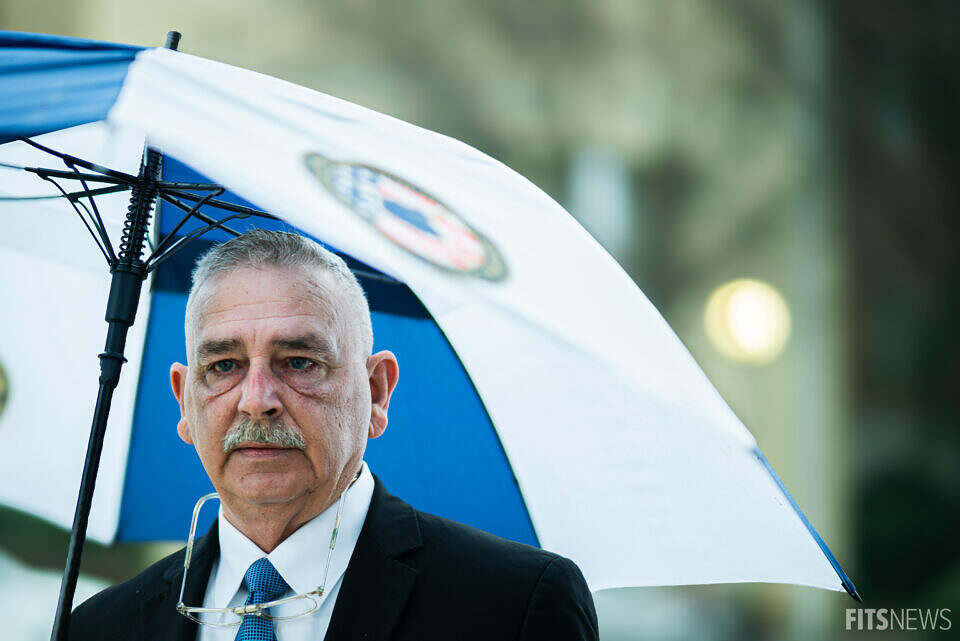
Whereabouts of convicted South Carolina sheriff unknown…
|
Getting your Trinity Audio player ready...
|
3 comments
Wright is not going to serve much time. Trump will pardon him. That’s why Attorney General Alan Wilson didn’t pursue state charges. South Carolina’s process is governed by the Department of Probation, Parole and Pardon Services.
A pardon isn’t necessary when the charging decisions already did the work.
Wright obtained 147 Schedule II opioid pills — bought from a street dealer in the sheriff’s office parking lot, in uniform, badge on, weapon on hip. The prosecutors charged 21 U.S.C. § 843(a)(3) — obtaining by misrepresentation. Maximum 4 years. No mandatory minimum.
They could have charged § 841 or § 846 — possession with intent or conspiracy to distribute — where the aggregate weight of 147 Schedule II tablets triggers mandatory minimums that remove judicial discretion entirely. That is what a civilian catches for the same pills.
The $89,000 Benevolence Fund theft was charged as conspiracy (§ 371, max 5 years) instead of the substantive offense (§ 666, max 10 years per count — and each withdrawal could have been a separate count). The twenty-year ghost deputy payroll was charged as a single conspiracy count (§ 1349) instead of substantive wire fraud (§ 1343, max 20 years per count — and twenty years of biweekly paychecks is roughly 520 individual fraudulent transactions).
Not charged at all: 18 U.S.C. § 242 (deprivation of rights under color of law), § 641 (theft of government property for the $17,000 in personal county credit card charges), § 1346 (honest services fraud), money laundering (a Benevolence Fund check written to a drug supplier), and the pill suppliers themselves — the street dealer who sold Schedule II narcotics to the sheriff walked as an unindicted co-conspirator.
Three counts. Conspiracy wrappers instead of substantive offenses. The lightest drug statute in the chapter. Stipulated loss amount agreed by both sides to produce a 33-41 month guideline range. Meanwhile, 10th Circuit Solicitor Micah Black — who declined state charges despite calling the evidence ‘overwhelming’ — routinely sends civilians to state prison for 11 to 25 years on drug trafficking charges.
And now the self-surrender. The BOP confirms he self-surrendered but he’s not at FCI Jesup — the facility his attorneys requested. He was ‘never designated’ there. He’s ‘not anywhere near’ there. He doesn’t appear in the BOP public inmate locator. The federal government’s position is: trust us, he’s in prison — we just can’t tell you which one. This is the same man whose whereabouts became ‘a subject of speculation’ sixteen months ago when he quietly checked into a Florida rehab while a federal grand jury was being empaneled. He disappeared then and he’s disappeared now. The system that tracks 150,000 federal inmates cannot tell the public where one convicted sheriff is sleeping.
A civilian who fails to self-surrender gets a warrant, a fugitive charge, and a US Marshals visit. A convicted sheriff gets the benefit of the doubt from the same system that convicted him.
The apparatus performed exactly as designed.
Self surrendered? Does he want a medal?