

|
Getting your Trinity Audio player ready...
|
by JENN WOOD
***
Clemson University is pushing back hard against allegations that its leadership is tied to a politically charged housing development in Oconee County, South Carolina.
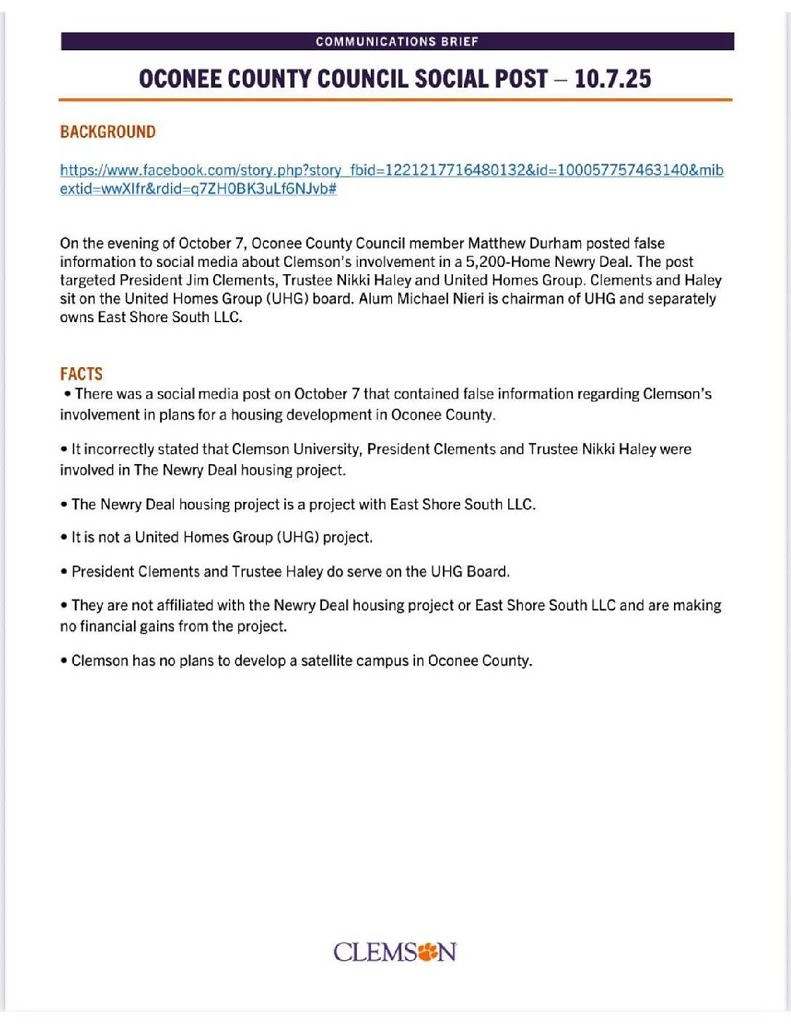
The school issued a communications brief issue last Tuesday (October 7, 2025) following a post from Oconee County Council chairman Matthew Durham – a local official who is leading the charge to block the development (and expose alleged conflicts of interest involving numerous Clemson luminaries).
In its brief, Clemson accused Durham of spreading “false information” about the school’s role in the proposed 5,200-home Newry Mill development. It further accused him of spreading misinformation about Clemson president James P. Clements and former South Carolina governor and United Nations ambassador Nikki Haley, one of Clemson’s seven unconstitutional lifetime trustees.
Both Clements and Haley sit on the board of United Homes Group (UHG), a company Durham insists is behind the Newry project. UHG is owned by Clemson mega-donor Michael Nieri.
The school has flatly denied those allegations, stating Durham’s post “targeted” Clements and Haley with falsehoods.
Take a look…
***
***
“(Durham) incorrectly stated that Clemson University, President Clements and Trustee Nikki Haley were involved in The Newry Deal housing project,” the statement read. “The Newry Deal housing project is a project with East Shore South LLC. It is not a United Homes Group project … Clemson has no plans to develop a satellite campus in Oconee County.”
The statement also insisted Clement and Haley are “making no financial gains from the (Newry) project.”
The message was clear: Clemson wants no part of this controversy.
But documents obtained by Durham tell a different story…
***
THE PENDLETON CONNECTION
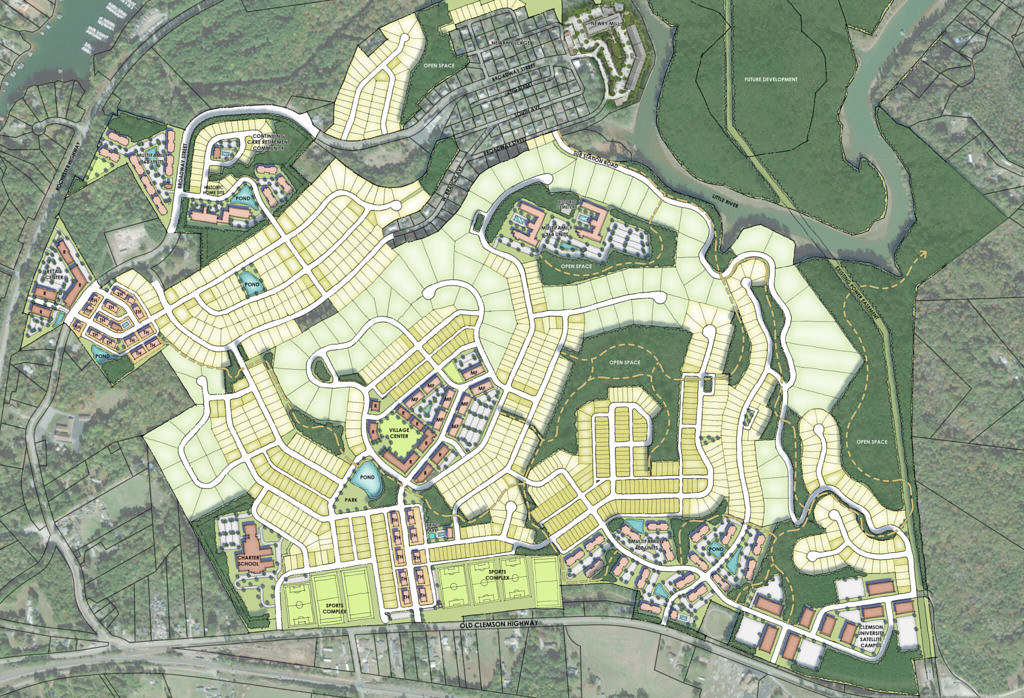
Just eight miles from the Newry site, its proposed developer is leading another major project: a taxpayer-subsidized redevelopment in the town of Pendleton, S.C. structured as a Tax Increment Financing (TIF) district.
Public records and planning-commission minutes have identified Mark Hart as the “major property owner” and “redeveloper” for Pendleton’s Village Hills Small Area Master Plan, a 207-acre redevelopment zone located squarely within Clemson’s orbit.
Hart is a former chief operating officer for the NFL’s Carolina Panthers – and was president of GT Real Estate Holdings, the company behind Panthers’ owner David Tepper‘s abandoned bid to bring the team’s headquarters and practice facility to the Palmetto State.
According to the town’s planning documents, Village Hills encompasses 160 parcels, roughly 25 acres of designated green space, and a large concentration of land once owned by Great Southern Homes — the Columbia-based company which merged into UHG, where both Clements and Haley sit on the board.
The Village Hills plan calls for public-private partnerships to implement the redevelopment – and explicitly encourages developers to partner with the town to “share responsibilities and benefits.”
***
RELATED | TIGER BY THE TAIL
***
A DEVELOPER IN ACTION
In November 2024, Pendleton planning-commission minutes (.pdf) revealed Hart appeared in person to present the plan – describing his company’s work with town officials and design consultants on a “special housing product for this area.”
By August 2025, Hart resurfaced under his United Builders banner (a UHG subsidiary) during a meeting where commissioners reviewed Design Guidelines for the Village Hills TIF District. While Hart remained silent that evening, his presence was noted in the official record (.pdf) — as the commission postponed approval to allow public feedback.
“Oconee County isn’t the only nearby Clemson community Mr. Hart has been courting,” Durham noted in a recent post. “He’s been making the rounds around Clemson looking for councils willing to say yes. We just happened to say no.”
Durham believes the Pendleton minutes confirm Hart’s dual identity: the same developer threatening Oconee County with annexation and lawsuits is simultaneously advancing a Clemson-adjacent redevelopment that depends on municipal debt and future taxpayer revenue. Durham says the documents also confirm Hart’s role with UHG.
“Don’t take our word for it,” Durham wrote. “According to public records, Mark Hart is a representative of Great Southern Homes/United Homes Group — the corporation on whose board President Clements, Trustee Haley, and mega-donor Michael Nieri serve.”
***
A FAMILIAR PLAYBOOK
Durham has previously accused Hart of trying to “bully” his government into approving the massive Newry proposal – even though its renderings reportedly fail to comply with county ordinance 2024-18, which limits density and lot size in an effort to protect the community.
In a September 15, 2025 letter (.pdf) to county administrator Amanda Brock, Hart’s company warned it did “not feel compelled to recognize ordinance 2024-18” and stated it might pursue “other legal and political responses” if its request was denied.
Durham’s reply was blunt.
“Maybe threats work against politicians in Pittsburgh and Charlotte — but they won’t work here,” he said.
Pendleton officials, by contrast, welcomed Hart’s involvement as part of a revitalization partnership — a distinction that underscores the developer’s adaptability. Where resistance arises, Hart wields leverage. Where access opens, he embeds.
The outcomes are strikingly similar: public financing, private control and the quiet expansion of Clemson’s development footprint without direct institutional fingerprints.

***
Durham also pointed to Clemson city council’s recent initial approval of a massive new mixed-use development within its municipal limits – a controversial project which includes a 700-bed apartment complex. Located on College Avenue – just north of the Clemson campus – this development is owned in part by a company called Two Blue Stallions, which according to Durham is yet another subsidiary of Great Southern Homes.
“Two Blue Stallions is Great Southern Homes — a subsidiary of United Homes Group, where Clements and Haley serve as board members,” Durham noted.
Durham also tied another co-owner of the College Avenue project – University Ridge LLC – to Great Southern Homes.
Clemson residents are leery of the impact of the massive new student housing development on their community, while transparency advocates are concerned it is yet another dimly lit deal with shady, secret political ties lurking in the shadows.
According to Durham, “these records outline a complex development network connecting Clemson University’s leadership to multiple projects across the region — a web of corporate and institutional relationships that raise serious questions about influence, accountability, and transparency in public decision-making.”
“Would the university care to provide a response to this?” Durham asked.
***
CLEMSON’S FIREWALL – AND ITS FRACTURES
Technically, Clemson University’s recent statement in defense of its president, trustee and donor is accurate: the university itself isn’t listed on any of Hart’s filings, nor does it hold title to the land in Oconee, Pendleton or the city of Clemson.
But the corporate overlap is undeniable. Clements and Haley both sit on the UHG board — the same company that succeeded Great Southern Homes (and the same company which owns dozens of parcels within the Pendleton TIF). And UHG chairman Nieri – whose name adorns multiple campus buildings – separately owns East Shore South LLC, the firm behind the disputed Newry project.
Clemson’s denial – which Durham described as “carefully worded” – draws a narrow line between affiliation and influence.
The university may not be signing deeds or collecting profits, but the entanglement of its leaders with developers driving Upstate sprawl has blurred the boundary between public mission and private enrichment.
“Clemson University should represent the best of higher education in South Carolina — not the worst of insider politics and corporate backroom deals,” Durham wrote.
These cases point to a deeper tension: how far South Carolina’s top public university can extend its economic reach before accountability evaporates. When the same small circle of leaders, trustees, donors and corporate executives shape growth across multiple counties — all tied to Clemson’s brand and political network — oversight becomes murky.
So does the definition of “false information.”
***
RELATED | CLEMSON’S FINANCIAL POSITION IS GETTING WORSE
***
“It’s a serious conflict-of-interest concern when the leadership of a rapidly expanding state-funded university serves on the very boards of corporations profiting from that explosive growth,” Durham wrote. “Transparency shouldn’t be controversial. It’s time for straight answers and accountability.”
In pushing for this transparency and accountability, Durham wants Clemson to “publicly disclose any and all financial, consulting, or development relationships between its leadership, trustees, or affiliates and United Homes Group, Great Southern Homes, East Shore South, Two Blue Stallions, or any related LLCs tied to development in Oconee, Pickens, or Anderson counties.”
He is also demanding any school trustee or leader tied to those entities to “recuse themselves from any university business that could directly or indirectly benefit those companies.”
Finally, Durham wants local leaders with the city of Clemson, Oconee County, Anderson County, Pickens County, and the the town of Pendleton to “release all correspondence, meeting notes, and communications with Mark Hart, East Shore South, Two Blue Stallions, Great Southern Homes, and United Homes Group, including any and all subsidiaries, affiliates, special-purpose entities, and related LLCs.”
“This isn’t just about one development,” Durham wrote. “It’s about who really runs our communities — and whether the people still have a say.”
***
ABOUT THE AUTHOR …
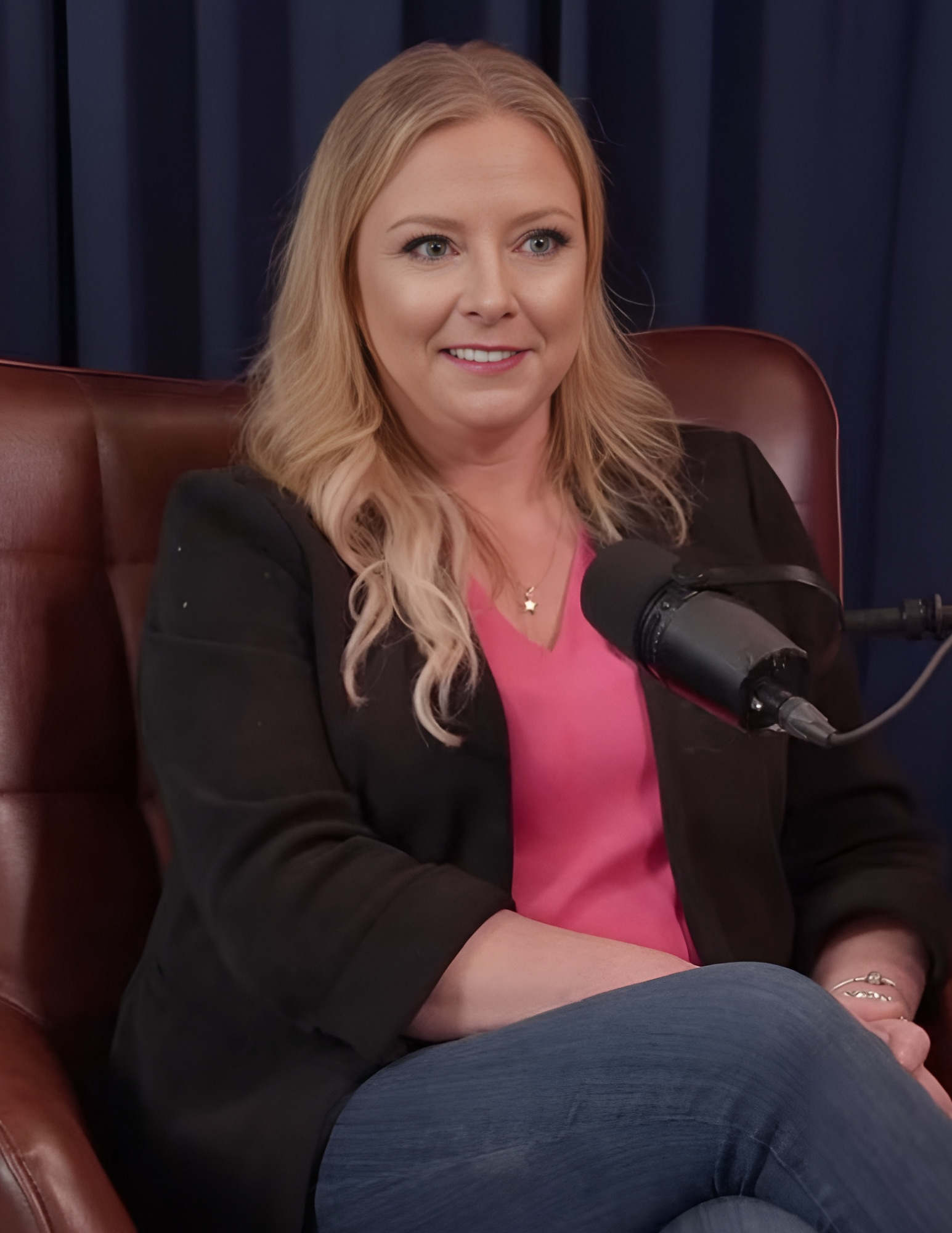
As a private investigator turned journalist, Jenn Wood brings a unique skill set to FITSNews as its research director. Known for her meticulous sourcing and victim-centered approach, she helps shape the newsroom’s most complex investigative stories while producing the FITSFiles and Cheer Incorporated podcasts. Jenn lives in South Carolina with her family, where her work continues to spotlight truth, accountability, and justice.
***
SOUND OFF…
Got something you’d like to say in response to one of our articles? Or an issue you’d like to address proactively? We have an open microphone policy! Submit your letter to the editor (or guest column) via email HERE. Got a tip for a story? CLICK HERE. Got a technical question or a glitch to report? CLICK HERE.

8 comments
Excellent article. So THANKFUL to have a source of real journalism right here in our state. Fitsnews is a breath of fresh air.
I agree 100%
No University President should be sitting on the board of a real estate firm, particularly one trying to do business in the same area of said university…………….
Me think thou (Clemson) doth protest too much.
Ill tell you whats not a falsehood, Haley committed false information and hoaxes to the Homeland Security.
So it wouldn’t be the first time she’s connected to something advantageous for her own personal gain through deception, misinformation or abuse of power.
I think its safe to explore the ideas despite clemsons reaction. There’s credibility here to explore.
Case Study: Schenectady, NY’s Downtown Revitalization Initiative (DRI, 2020)
In Schenectady, a $10M state-funded DRI aimed to boost downtown vibrancy through projects like event spaces and aquatic centers. However, the Local Planning Committee included powerful figures (e.g., casino executives, development authority heads) who proposed and voted on self-interested initiatives, such as funding for their own venues at Mohawk Harbor.
Impacts: Economic boosts (e.g., tourism jobs) were overshadowed by conflicts, with critics noting taxpayer funds funneled to insiders without robust community buy-in. Environmental reviews were rushed, raising flood-risk concerns near the harbor.
Citizen Effects: Residents reported feeling sidelined, with good-government advocates like Reinvent Albany highlighting eroded trust and calls for conflict disclosures. The process accelerated approvals but at the cost of transparency, mirroring broader “pay-to-play” risks in U.S. development.
Lessons: Stronger recusal rules and diverse panels could mitigate harms, as recommended by ethics bodies like the OECD.
On the other hand, Nikki is a strong character in south carolina with her alliance to Clemson and overall interests in a better South Carolina as a whole. She isn’t a mafia crime boss with hopes of a dog track being approved.
Its good to bring up the ones involved in this project but its also good to highlight the good.
Community Impact:
Students: More housing options reduce competition for apartments, potentially stabilizing rents and improving living conditions (e.g., modern amenities like Hub’s rooftop pool).
Residents: Less student spillover into family neighborhoods preserves community character, addressing complaints about “student takeover” voiced at 2024 council meetings.
University: Frees up resources to focus on academics and facilities (e.g., CU-ICAR expansion) rather than dorm construction.
Why It Matters: A balanced housing market supports Clemson’s identity as a livable college town, benefiting everyon e from renters to homeowners.