
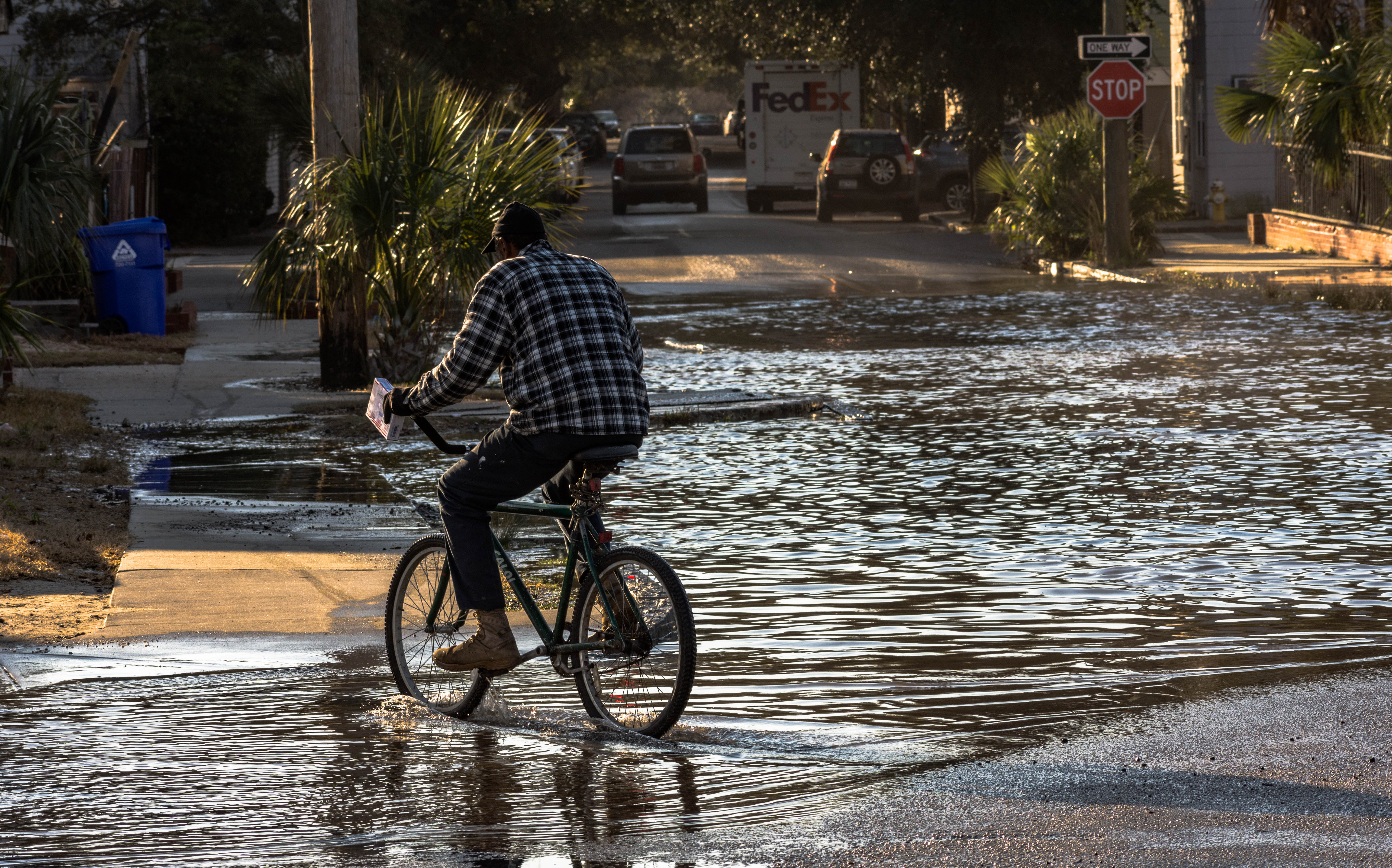
Image default
SC

Guest Column: Lawfare Will Not Solve Charleston’s Flooding Problem

Michael Burris: “A headline-grabbing lawsuit is easy, but balancing vibrant development and environmental protection is much harder.”

Getting your Trinity Audio player ready...

by MICHAEL BURRIS

***

It’s high time for Charleston, South Carolina’s city council to drop its beleaguered climate lawsuit and continue to focus on the real solutions to our flooding problem.

Charleston’s city council and its Mayor, William Cogswell, have proven their ability to work across party lines and government agencies to protect the city from sea level rise and flooding. Unlike those efforts – which directly address the flooding impacts that our city faces, make communities safer, and create jobs in South Carolina – Charleston’s climate lawsuit against energy companies is a waste of time and money. 

Earlier this month, a state judge handily dismissed Charleston’s five-year old climate lawsuit, which seeks to hold oil and natural gas companies liable for the effects of climate change in coastal South Carolina.

South Carolina Circuit Court Judge Roger Young made it clear that Charleston’s lawsuit should not be allowed to proceed because it seeks to regulate interstate and global greenhouse gas emissions, which can only be regulated by the federal government according to Supreme Court precedent. A spate of state judges in New York, New Jersey, and Maryland have tossed similar cases on the same logic. 

Support FITSNews … SUBSCRIBE!

***

Judge Young pointed out that if Charleston’s lawsuit were successful, “municipalities, companies, and individuals across the country could bring suits for injuries after every weather event,” creating an almost “limitless” theory of liability. Such a legal minefield would signal that Charleston is not open for business.

Worse, a successful verdict would discourage investment in necessary energy resources, driving up household energy prices in South Carolina while only rewarding the San Francisco plaintiffs’ attorneys hired to try the case.

Now, the Charleston City Council will decide at its August 19, 2025 meeting whether to appeal Judge Young’s unequivocal dismissal. The answer is clear: Charleston should drop its legal campaign against fossil fuels and focus instead on the innovative and effective climate mitigation efforts that are already underway in our city and state.

Take, for example, Charleston’s participation in the state’s oyster recycling program. Through collaborations with community volunteers and environmental nonprofits, recycled oysters are used to construct reefs in coastal areas to provide natural surge defense and restore native ecosystems.

Charleston is also investing heavily in infrastructure to keep our city safe from weather events. As part of the $198 million Spring-Fishburne Drainage Project, the new Lockwood Drive pump station can now move enough water to fill an Olympic-sized swimming poll in two minutes. The city has further committed additional tens of millions towards the Battery seawall expansion project, which will improve both storm drainage and walkability along the promenade.

***

RELATED | JUDGE TOSSES CHARLESTON CLIMATE LAWSUIT

***

And just last month, Mayor Cogswell signed an agreement with the Army Corps of Engineers to improve stormwater drainage. As part of the agreement, The U.S. Corps of Engineers will improve the structural integrity of our city’s hundred-year-old storm water tunnels and support the design of a next-phase Dupont-Wappoo watershed plan. These investments will ensure that Charleston is a safe and sustainable place to live for decades to come.

Our City Council and Mayor are doing the right thing by re-investing in our communities and natural ecosystems. At the state level we have seen commitments and investment into nuclear energy and liquified natural gas as we look towards the future of energy in South Carolina.  But amidst collaborative projects that improve quality of life, build climate resilience, and sustain jobs, the city’s climate lawsuit stands out as a waste of time and taxpayer dollars.

The reality is that filing a headline-grabbing lawsuit is easy, but balancing vibrant development and environmental protection is much harder. Charleston should be known as a city that does the hard things well. Our City Council must take this opportunity to ditch its ill-fated legal campaign, and continue real efforts to protect our coastlines and communities through real, measurable action.

***

ABOUT THE AUTHOR…

Michael Burris is an eighth-generation Charlestonian, former naval officer and the CEO of the South Carolina Policy Council, a free-market public policy research organization dedicated to promoting innovative and practical solutions to the state’s everyday issues and economic challenges.

***

WANNA SOUND OFF?

Got something you’d like to say in response to one of our articles? Or an issue you’d like to address proactively? We have an open microphone policy! Submit your letter to the editor (or guest column) via email HERE. Got a tip for a story? CLICK HERE. Got a technical question or a glitch to report? CLICK HERE.

***

Subscribe to our newsletter by clicking here …

*****

Related posts

SC

For Two Quiet Hours, Every Child Belonged at the South Carolina State Fair

Jenn Wood
SC

Parents Demand S.C. Charter Board Revoke School Operator’s Contract

Dylan Nolan
SC

Parents To Stage Walkout Of South Carolina Charter School

Dylan Nolan

7 comments

Avatar photo
The Colonel Top fan August 19, 2025 at 10:10 am

Charleston’s flooding problem has far more to do with “subsidence” than it does with “climate change”. Charleston is sinking about 1/4th of an inch every year because of the weight of the buildings and infrastructure Charlestonians built on top of a swamp.

That means that while the Global sea level rise at .06 inches per year will cause the sea to have risen 1.5 inches by 2050. Meanwhile, Chucktown will have settled 6.25 inches. If we extrapolate to 2100, the difference is 18 inches of subsidence versus 4 inches of “sea level rise”.

Let me ask you, which problem can we actually control? Which problem has the greatest impact?

Don’t believe me? Google “Exposure of communities and infrastructure to subsidence on the US east coast Leonard O Ohenhen”.

Charleston’s problems were created by Charlestonians, not the “evil climate change boogie man”.

Reply
CongareeCatfish Top fan August 19, 2025 at 4:06 pm

Thanks for pointing this out Colonel – subsidence does not get nearly enough attention in this multi-faceted problem. . It should also be noted that according to the State Office of Resilience, since 1992, over 10000 acres of natural forestland in the Charleston metro area have been developed into buildings, roads and other largely impervious surfaces. I asked Grok to quantify what that would mean in terms of actual measurable surface level runoff. Assuming an annual rainfall rate of about 50 inches per year and a standard hydrology runoff coefficient rate of0.995 for impervious surfaces, you are looking at approximately 13.1 billion gallons (or 40,292 acre-feet) of additional annual runoff. Grok also observed that “This extra volume overwhelms drainage systems, increasing peak discharge by up to 240%, runoff volume by 35%, and altering lag time by 85% in urban settings, per general studies (applicable to Charleston). In Charleston’s Calhoun West basin (322 acres, high imperviousness), similar runoff contributes to flood depths of 0.1–2.4 feet during combined SLR and storm events. Overall, it has helped drive a 409% increase in flood days (from ~2/year in the 1970s to ~25/year by 2010–2015).”

So, in other words, man-made climate change has, at best (and this is a big maybe) about a 1/4 to 1/3 causal factor in the Charleston metro area flooding – and that is being very charitable. What also further proves this and the Colonel’s point about subsidence is when you compare local area sea level rise and surface area flooding of the ACE basin (a mere 60 miles south of Charleston harbor as the crow flies) you find that the ACE basin doesn’t experience anything close to the frequency and magnitude of Charleston’s flooding, and significantly less sea level rise. Because it’s not hyper-densely developed with billions of tons of man made structures compressing the silt based soil, and only has a small fraction of the surface rainwater runoff – which permits the water table to be re-charged and thus retards subsidence – the two factors are interconnected.

Reply
Avatar photo
The Colonel Top fan August 19, 2025 at 9:15 pm

Charleston’s council has only recently begun to get serious about rainwater runoff. There are parking lots along the Ashley and in Harleston Village that look more like ponds after any rain. Their insistence on getting the runoff into the harbor rather than letting it soak in as you say just makes it all worse. The micro lot developments in the suburbs, Summerville and Goose Creek are going to going to create more problems along the I-26 corridor. Chucktown is being loved to death because no one knows when to say no.

Reply
Facts August 21, 2025 at 5:48 am

Most reliable sources list Charleston’s subsidence at a max of 4mm or just over 1/8th inch per year (0.15748 inches per year to be exact). Most sources also quote the current average sea level rise at 3.6 mm per year (0.141732 inches per year) and rising. So it would appear that currently subsidence and sea level rise are of almost equal threat to Charleston. Facts matter.

Reply
Anonymous August 19, 2025 at 2:12 pm

Why is Young even still on the bench? Has all the past exposure of bad judgements and crazy small sentences been scrubbed from the world wide web?

He is almost as bad as Jefferson who has violated due process rights and passed judgements without hearing from litigants!

Reply
Anonymous August 19, 2025 at 3:03 pm

For well over 30+ years the same spot on Folly Road – James Island – still a danger to motorist due to the Charleston City Council not lifting a single finger to the flooding. They are worthless do nothing’s.

Even the flooding on Tobias Gadsden right before Paul Cantrell Blvd. Decades of the same old ignored crap by the city. Easy fix, too. If only the city’s road crews knew how to use a shovel to dig a small trench or two so rain water would drain down off the road where it builds up causing motor vehicles to hydroplane, etc.

Dozens and dozens of the things the City of Charleston should be doing that it’s is undoubtedly too lazy to do! Even the City PD can’t do what they should because they are short well hundreds of officers But they have the money and then some for it. What in the hell are they diverting it too?

Reply
Joebiden69 Top fan August 19, 2025 at 4:46 pm

You know what this needs? A Dutch Dialogue!

Reply

Leave a Comment