|
Getting your Trinity Audio player ready...
|
by JENN WOOD
***
A South Carolina judge has issued a protective order in the high-profile wrongful death lawsuit tied to the fatal roadside shooting of 33-year-old North Carolinian Scott Ryan Spivey — clearing the way for an upcoming “Stand Your Ground” hearing that could determine whether the case proceeds to trial.
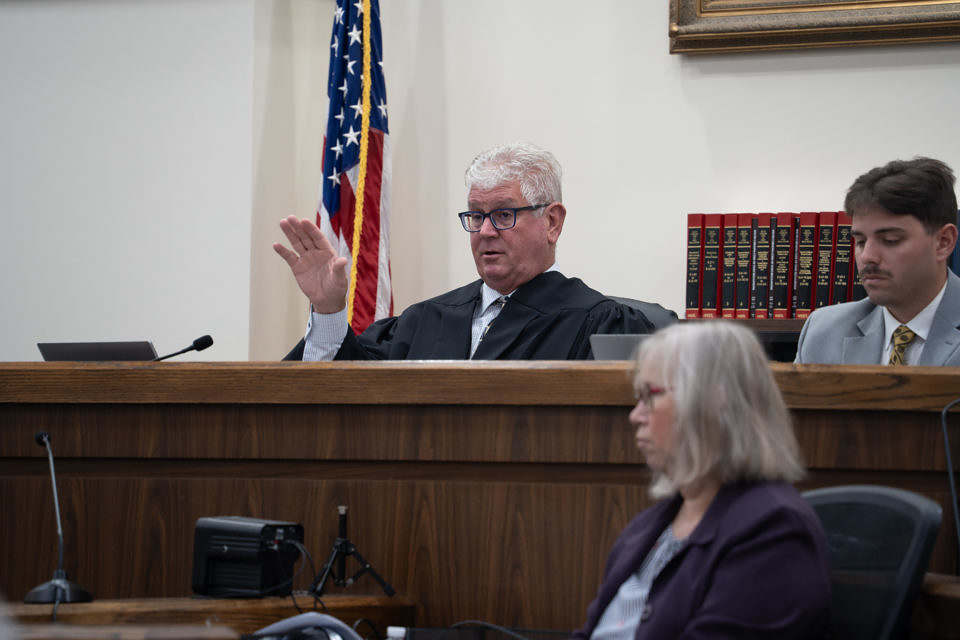
During a nearly hour-long hearing on Thursday (July 10, 2025) in Laurens County, S.C., circuit court judge Eugene C. Griffith, Jr. ruled that all future discovery in the case — including medical records, cell phone data, social media messages and recordings — will be shielded from public dissemination and restricted to attorneys and experts involved in the case.
“I want to start from right now and move forward and do what we can to work together, correct, advocate for our clients and minimize the potential impact on the jury,” Griffith said.

***
The ruling came after spirited debate between attorneys for the defendants and plaintiffs’ lawyer Mark Tinsley, who represents Spivey’s sister in the civil case. Tinsley agreed to the order – but raised First Amendment concerns over what he described as a parallel public corruption investigation into Horry County law enforcement.
“There are two cases going on here,” Tinsley said. “We’ve got (the) Horry County corruption aspect, which is at this point beyond debate. It’s acknowledged by Horry County in this investigation. They have fired their number two man at Horry County. They fired a 23-year veteran of the force for corruption.”
Defense attorneys objected to this framing, insisting the case should remain focused solely on the fatal confrontation between Spivey and the two defendants, Charles Weldon Boyd and Kenneth Bradley Williams.
***

***
“There’s not two cases going on here,” said Morgan Martin, attorney for Williams. “Whatever the Horry County Police Department (HCPD) did or didn’t do, and that investigation … isn’t what this case is about.”
Kenneth Moss, who represents Boyd, accused Tinsley of trying the case in the press.
“The lawyer should be shut down,” Moss said. “I think he’s the problem, to be quite candid.”
The court’s protective order applies not only to lawyers and clients, but also to expert consultants. Griffith emphasized discovery materials are not to be used outside the legal proceedings.
“Experts … cannot go behind your back, whether you hire them or not,” he said. “They’re going to be restricted under the same restrictions, just like in every other case.”
***
RELATED | ‘STAND YOUR GROUND’ SHOWDOWN
***
THE INCIDENT
The wrongful death case stems from the fatal September 9, 2023 shooting of Spivey, an insurance adjuster from Tabor City, North Carolina. According to court filings, Spivey was followed for several miles through rural Horry County by Boyd and Williams.
The defendants claimed Spivey was driving recklessly and brandishing a gun. After pulling off on Camp Swamp Road near the North Carolina border, Spivey was shot and killed — struck in the back by one of multiple rounds fired by the two men.
Authorities initially ruled the shooting was justified under South Carolina’s ‘Protection of Persons and Property Act’ – a.k.a. its “Stand Your Ground” law. But Spivey’s sister, Jennifer Spivey Foley, dug into the case personally – with her findings prompting deeper scrutiny of how the shooting was investigated. Audio recordings, cell phone data, and internal law enforcement communications revealed irregularities — including missing or mislabeled dash cam footage and apparent coordination between Boyd and senior Horry County officers in the immediate aftermath of the shooting.
Public outcry over the case triggered internal investigations and disciplinary action within HCPD — while conflicts in Horry County courts led the state supreme court to appoint Griffith to preside over the civil suit. At the heart of the legal battle is whether Boyd and Williams were legally justified in using deadly force — or whether their actions exceeded the protections afforded under the state’s self-defense laws.
***
RELATED | UNSOLVED CAROLINAS: THE ROADSIDE SHOOTING OF SCOTT SPIVEY
***
HIGHLIGHTS OF THE HEARING
Much of Thursday’s hearing focused on procedural matters, including how the upcoming ‘Stand Your Ground’ hearing would be structured and what evidence would be admissible. Judge Griffith emphasized that the court — not a jury — will decide whether immunity applies.
He also made it clear key witnesses would be compelled to appear and provide testimony.
“I don’t envision having a stand your ground hearing without those folks here,” Griffith said, referencing the 911 callers who reported Spivey’s behavior. He then encouraged both sides to make “best efforts” to locate and coordinate testimony from key out-of-state witnesses, several of whom have stopped cooperating after being targeted online.
Attorneys for the defendants previewed their case, asserting Spivey was intoxicated, waving a firearm and behaving erratically in the moments leading up to the shooting. They argued Boyd and Williams fired in self-defense after Spivey pointed a pistol at them and fired first.
“The facts are clear,” said Martin. “Mr. Spivey initiated this incident. He was the aggressor.”
***

***
Tinsley rejected that framing — and blasted a defense motion to obtain a preserved hair sample from Spivey for steroid testing. He called the motion a “fishing expedition” and said toxicology reports had already found no drugs in Spivey’s bloodstream.
“Let’s not put my client to the expense of responding to junk science,” Tinsley said.
Defense attorneys argued that evidence of steroid use — even if dated — could help explain Spivey’s behavior and mental state.
“This is not a novel issue that’s never been addressed,” said Martin. “It’s routinely done … especially in the criminal courts in South Carolina.”
Judge Griffith said he would take the matter under advisement.

***
WHAT’S NEXT…
The parties agreed to begin preparations for the Stand Your Ground hearing, including reaching out to out-of-state witnesses and exchanging key discovery materials under the new protective order. Griffith encouraged both sides to minimize media commentary going forward — and indicated he would consider further discovery and evidentiary disputes on a case-by-case basis.
“This is a serious case with serious allegations,” Griffith said. “We’re going to proceed thoughtfully and efficiently.”
No date was set for the hearing, though scheduling discussions are expected once the parties confirm witness availability.
FITSNews will continue to provide in-depth coverage of this case — including its implications for South Carolina’s Stand Your Ground law and ongoing allegations of misconduct within the Horry County Police Department.
***
ABOUT THE AUTHOR …
As a private investigator turned journalist, Jenn Wood brings a unique skill set to FITSNews as its research director. Known for her meticulous sourcing and victim-centered approach, she helps shape the newsroom’s most complex investigative stories while producing the FITSFiles and Cheer Incorporated podcasts. Jenn lives in South Carolina with her family, where her work continues to spotlight truth, accountability, and justice.
***
WANNA SOUND OFF?
Got something you’d like to say in response to one of our articles? Or an issue you’d like to address proactively? We have an open microphone policy! Submit your letter to the editor (or guest column) via email HERE. Got a tip for a story? CLICK HERE. Got a technical question or a glitch to report? CLICK HERE.


1 comment
Hmm, good luck with that gag order your judgeship. IF you’re trying to keep this out of the socialmediasphere, you just guaranteed that it will become a big deal. IF you’re trying to protect the good ol’boys of the Horry County PD (Whorey County is appropriately named) you’ve missed the boat. IF you’re trying to avoid “tainting the jury pool” it won’t work (and most Whorey Countians don’t pay attention to anything but the golf weather anyway)