
|
Getting your Trinity Audio player ready...
|
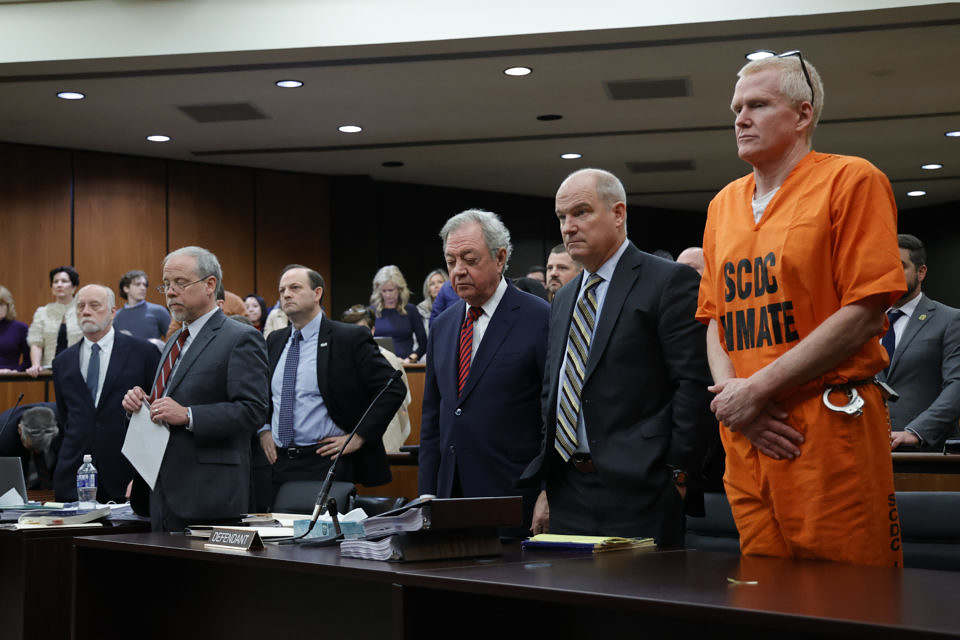
In one of the most consequential legal showdowns in South Carolina history, convicted killer Alex Murdaugh’s defense team has filed its reply brief on his appeal to the S.C. supreme court — the last written word before the court’s five justices determine whether to grant the disbarred attorney a new trial.
The former Lowcountry power broker – once a badge-carrying assistant solicitor and the face of a century-old legal dynasty – is currently serving two life sentences for the June 2021 murders of his wife, Maggie Murdaugh, and younger son, Paul Murdaugh. Now, with the defense’s reply brief filed, the Palmetto State’s high court will establish the process by which it will either overturn – or uphold – outcome of one of the most sensational trials (and controversial verdicts) South Carolina has ever seen.
Filed by attorneys Dick Harpootlian, Jim Griffin, Phillip Barber and Maggie Fox, the reply brief (.pdf) represents the defense team’s most forceful attempt to persuade the justices that Murdaugh was denied a fair trial.
Prosecutors have already called the case against Murdaugh “overwhelming” – and dismissed documented jury tampering as the “foolish and fleeting” actions of a former clerk of court. But in their reply, Murdaugh’s lawyers countered that the conviction was “built on investigative failures, fabricated evidence, and jury tampering.”
They insist the state “ignored exonerating evidence, misrepresented forensic findings, and relied on inflammatory but irrelevant financial evidence to distract from the absence of proof that Alex committed these murders.”
***
FLAWED INVESTIGATION: ‘FUNDAMENTALLY COMPROMISED FROM THE BEGINNING’
The defense brief began with a sweeping, stinging indictment of law enforcement’s handling of the case — characterizing prosecutors’ presentation of a “thorough investigation” as pure fiction. According to the filing, the investigation “was fundamentally compromised from the beginning.”
“First responders trampled through the crime scene and feed room, destroying potential evidence including bloody footprints that may have belonged to the actual perpetrator(s),” they noted.
Investigators from the S.C. State Law Enforcement Division (SLED) allegedly compounded these mistakes when their forensic analysts “did not attempt to lift fingerprints from the feed room doors, doorknobs, or entrance area where Paul was murdered — a fundamental failure in any homicide investigation.”
The brief also highlighted what it called “ignored alternative suspects.”

***
Tire tracks visible in wet grass — tracks which did not match any Murdaugh vehicles — were “never followed or investigated, demonstrating investigative tunnel vision from the outset.” And, according to testimony cited by the defense, SLED’s lead investigator admitted they “conduct investigations ‘concentrically’ but … never eliminated (Murdaugh) from their investigative circle and never included anyone else within it.”
“This reveals investigative bias rather than objective inquiry,” Murdaugh’s attorneys alleged.
Perhaps the most striking example provided by the defense in its response involves forensic evidence investigators allegedly failed to submit to the FBI’s Combined DNA Index System (CODIS).
“SLED identified DNA from an unknown male under Maggie’s fingertips but never submitted this potentially exonerating evidence to CODIS for comparison — a basic investigative protocol that could have identified the real perpetrator,” they noted.
The brief also pointed out SLED’s alleged mishandling of Maggie Murdaugh’s iPhone, which resulted in permanent loss of location data from the night of the murders.
“SLED’s failure to use a basic Faraday bag or simply turn off the phone displays investigative malpractice,” they wrote.
***
RELATED | MURDAUGH PROSECUTORS SAY EVIDENCE ‘OVERWHELMING’
***
FABRICATED AND MISREPRESENTED EVIDENCE
Next, the reply turns to what it calls “the blood spatter fabrication” — the linchpin of the defense’s argument that the state’s case was built on sand. The defense accused investigators of “false grand jury testimony” when a lead agent told jurors loaded shotguns at Moselle matched the shells used to kill Paul Murdaugh, and that Alex Murdaugh’s clothing contained high-velocity impact spatter. Both claims, the brief argued, were false.
“(SLED) flew to Oklahoma to pressure their ‘blood spatter expert’ into changing his initial report that found no blood spatter evidence,” Murdaugh’s attorneys wrote. “When SLED’s own lab report definitively determined there was no human blood on Alex’s shirt, the State abandoned this fabricated evidence rather than acknowledge their misconduct.”
Even after abandoning the spatter claim, prosecutors pivoted mid-trial rather than acknowledge the mistake.
“Rather than admit the fabrication, the state simply shifted to arguing that Murdaugh changed his clothes after the murders — a theory unsupported by any evidence,” they wrote.
Ballistics testimony fared no better in the defense’s retelling. Specifically, they argued the state’s expert relied on “unsupported assumptions” — specifically, that every .300 Blackout firearm left unique extraction marks. However, “the SLED ballistics witness did not – and could not – offer an opinion that any of the specific weapons seized from Moselle were used to murder Maggie or Paul.”
***
NO CREDIBLE MOTIVE: ‘DEFIES LOGIC AND HUMAN EXPERIENCE‘
During the trial, prosecutors leaned heavily on the “gathering storm” narrative – that Murdaugh’s impending ruin as a result of his many financial misdeeds – was his motive for murder. The defense cast that narrative as nothing short of absurd. “
The suggestion that someone would commit double murder to delay routine legal proceedings defies logic and human experience,” their reply brief declared.
Attorneys underscored testimony that undercut the notion Murdaugh was facing an urgent financial crisis. Specifically, they cited his attorney in a high-profile wrongful death case – who testified a hearing scheduled for three days after the murders was “routine and not especially concerning.”
“Nothing explosive was expected” from those proceedings, the brief noted.
The defense also reminded justices that even prosecutors seemed to lose faith in their own motive theory during trial.
“During closing arguments, when the defense argued the motive theory was ‘unbelievable,’ the prosecutor responded that the jury could disregard their motive theory entirely and find Murdaugh guilty because the state is not required to prove motive, only malice — an admission that even the state recognized the weakness of their theory,” Murdaugh’s attorneys wrote.
***
RELATED | ALEX MURDAUGH’S APPEAL: THE KEY ARGUMENTS
***
LACK OF PHYSICAL EVIDENCE: ‘NO VISIBLE BLOOD, NO MURDER WEAPON’
The reply brief also emphasized what prosecutors could not produce.
“Despite the state’s claim that Paul’s killer would have been covered in blood and brain matter … Alex had no visible blood on his clothing or person when law enforcement arrived,” they wrote. “His clothing appeared fresh and clean, as if it had just come from the laundry.”
Gunshot residue evidence, they argued, was equally weak.
“Only two particles of gunshot residue were found on Alex’s hands, three on his shirt, three on his shorts, none on his shoes, and one on his vehicle’s seat buckle — consistent with handling the shotgun he retrieved for protection after discovering the bodies,” they wrote.
And while investigators pointed to DNA, the filing noted what was recovered was “consistent with Alex touching the bodies to check for signs of life” — a far cry from definitive proof. Critical leads, like “unknown DNA” under Maggie’s fingernails, were never followed up.
***
RELATED | FORMER CLERK ARRESTED
***
JURY TAMPERING ALLEGATIONS
The centerpiece of the defense’s reply brief is its claim that Colleton County then-clerk of court, Rebecca “Becky” Hill tainted the jury and deprived Murdaugh of his constitutional right to a fair trial. The filing accused Hill of blatant self-interest, noting she “published a book about the trial … and repeatedly stated during proceedings that a guilty verdict would sell more books because ‘she needed a lake house.’”
Jurors themselves, according to the brief, reported that Hill inserted herself into their deliberations, urging them “not to let the defense ‘throw you all off,’ ‘distract you or mislead you,’ and ‘not to be fooled’ by Alex’s testimony in his own defense.”
The defense insists those remarks crossed the line from mere commentary to constitutionally impermissible advocacy inside the jury room.
But the reply brief doesn’t stop with Hill’s conduct. It zeroed in on how former S.C. chief justice Jean Toal handled Murdaugh’s motion for a new trial during a high-profile evidentiary hearing in January 2024. The defense stated Toal applied the wrong legal standard — one that improperly placed the burden on Murdaugh to prove the tampering changed the verdict, rather than requiring the State to prove the misconduct was harmless.
***

***
“When a state official communicates with jurors about a criminal case during trial, the law presumes the tampering was prejudicial to the defendant’s right to a fair trial,” the filing stated.
In the defense’s telling, Toal effectively created a new rule: that Murdaugh had to prove “what the verdict would have been but for that tampering.” The reply insists this was error, because under Remmer v. United States, the presumption of prejudice attaches whenever jurors are improperly influenced during deliberations — and it becomes the prosecution’s burden to show those communications were harmless.
To underscore the gravity of Hill’s actions, the defense quoted directly from its brief: “There is no ‘overwhelming evidence’ exception to the right to a fair trial. At a minimum this would require the man have a right to a trial without an elected official advocating the guilt of the accused in the jury room during trial for her own personal profit.”
By combining Hill’s alleged misconduct with what they call Toal’s “erroneous legal standard,” the defense casts the verdict as irreparably tainted — an outcome that can only be remedied by granting Murdaugh a new trial.
***
THE FINAL WORD & WHAT’S NEXT
To the defense, the absence of reliable forensic proof — combined with what they called investigative “tunnel vision” and jury tampering — left only one conclusion: “Alex Murdaugh’s conviction resulted from a perfect storm of investigative incompetence, prosecutorial misconduct, and court official corruption — not from reliable evidence of guilt beyond a reasonable doubt.”
With this reply now filed, the case shifts squarely to the five justices of the high court. The filing represents the defense’s final written word before the court decides whether to grant Murdaugh a new trial. The justices could schedule oral arguments in the coming months, or issue a ruling based solely on the briefs.
Either way, the next move rests entirely with the state’s highest court — and their decision will determine whether one of the most sensational verdicts in South Carolina history stands, or whether it will be retried.
***
THE REPLY…
(S.C. Supreme Court)
***
ABOUT THE AUTHOR …
As a private investigator turned journalist, Jenn Wood brings a unique skill set to FITSNews as its research director. Known for her meticulous sourcing and victim-centered approach, she helps shape the newsroom’s most complex investigative stories while producing the FITSFiles and Cheer Incorporated podcasts. Jenn lives in South Carolina with her family, where her work continues to spotlight truth, accountability, and justice.
***
WANNA SOUND OFF?
Got something you’d like to say in response to one of our articles? Or an issue you’d like to address proactively? We have an open microphone policy! Submit your letter to the editor (or guest column) via email HERE. Got a tip for a story? CLICK HERE. Got a technical question or a glitch to report? CLICK HERE.


1 comment
If only he fought his homicidal urges this hard.