
|
Getting your Trinity Audio player ready...
|
A police department in South Carolina’s Lowcountry is once again making headlines, this time for stalling a Freedom of Information Act (FOIA) request tied to a traffic stop involving a black activist the agency had once praised on Facebook.
While the North Charleston Police Department (NCPD) has since apologized for 111 days of “confusion and delay,” it took repeated follow-ups to even partially secure the second half of our open records request — which came with a string of emails citing internal limitations.
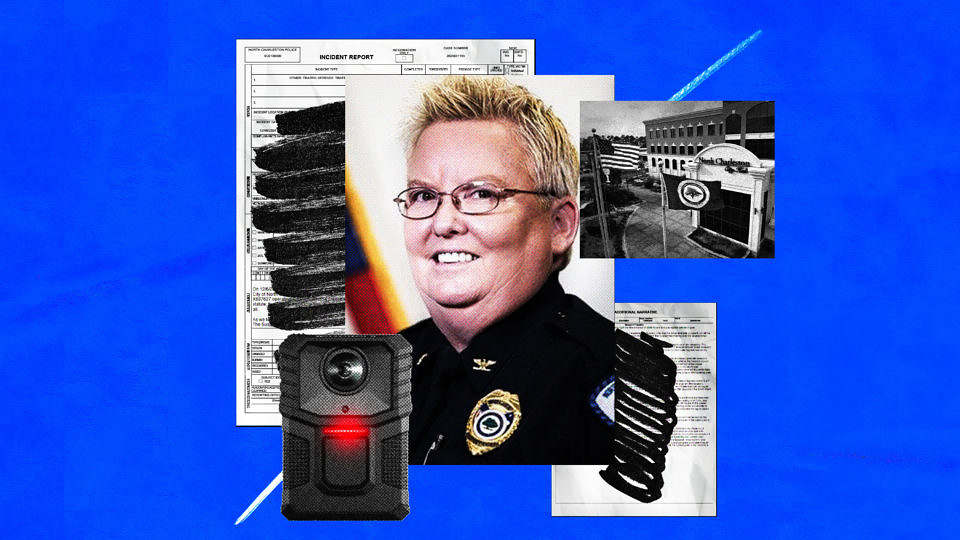
Those emails came directly from associate police chief Karen Cordray, the same official previously embroiled in another transparency scandal – one in which the city’s human resources department determined she had not been “entirely truthful” during an internal investigation.
Following that conclusion, Cordray — a 33-year NCPD veteran earning $120,149 last year — received an undisclosed pay raise under newly appointed chief Ron Camacho, who assumed command after the previous chief’s abrupt resignation last fall.
By structure, Camacho reports to North Charleston Mayor Reginald “Reggie” Burgess — a former NCPD chief whom Cordray publicly credited with promoting her to third-in-command during a 2018 visit to her parents’ house.
Needless to say, the currents in North Charleston carry more than water.
***
THE FAVOR…
***
One of the largest police departments in South Carolina, NCPD has developed a reputation for controversy — including allegations of command-level interference and excessive force in 2024, as well as a pursuit that ended in a fatal crash outside city limits this past April.
Adding to the city’s turmoil under Burgess’ leadership, three North Charleston city councilmen — along with five civilians — were indicted in February following a year-long federal corruption probe that uncovered a web of alleged bribery, kickbacks, extortion and money laundering.
“These council members used their positions not to serve their communities, but to enrich themselves,” said then-acting U.S. attorney Brook Andrews. “The people of North Charleston deserve better. All South Carolinians deserve better.”
While NCPD reports directly to the mayor — a former police chief who promoted Cordray — and is ultimately overseen by the same city council where three members were federally indicted, the department’s ties to those officials are more than just bureaucratic.
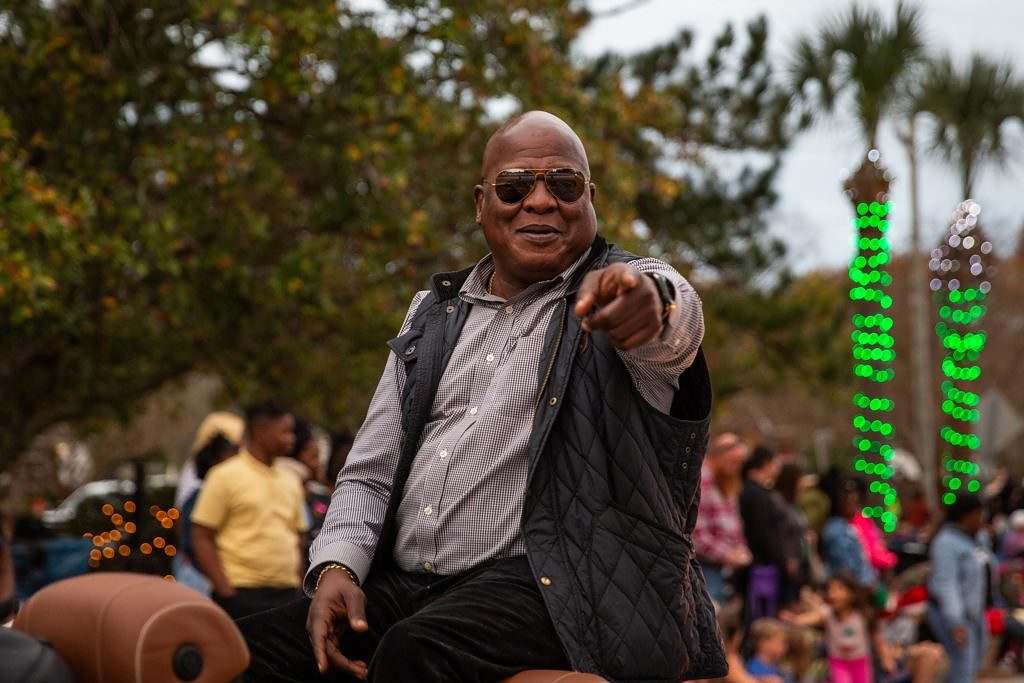
One of the now-former councilmen named in the federal probe is Jerome Heyward — the same politician at the center of an unrelated months-long saga that culminated in an internal misconduct complaint against Cordray for allegedly showing him undue favoritism.
According to body-worn camera footage from that incident, it began last year when Heyward refused to lower “unreasonably loud” music on the patio of a restaurant he was managing at the time. Instead of complying with Sgt. James Ryan III’s instructions, he called Cordray.
***
***
“I’m gonna settle this once and for all,” said a visibly intoxicated Heyward on video, dialing Ryan’s superior and handing over his phone. “Here’s your chief.”
Over the councilman’s blaring music — which had already prompted two noise complaints that evening, per police records — the officer spoke with Cordray using Heyward’s phone.
After informing NCPD’s third-in-command of a “legitimate noise complaint,” Ryan opted to document the incident in a report.
No citation was issued to Heyward or his establishment.
Months later, Ryan filed an internal complaint with NCPD, claiming Cordray engaged in “unethical conduct” by instructing him to “limit [his] incident report” and omit what he considered crucial details about his interaction with Heyward.

***
A 60-page internal investigation (.pdf) launched in response to the complaint detailed the officer’s full account: that Cordray not only gave the directive, but also told him to relocate his original narrative about Heyward’s conduct into a separate “case management note.”
Fearing the original report might be altered without his knowledge, Ryan wrote above his signed statement that he had retained a copy. He later described Cordray’s directive as “unethical,” noting that NCPD personnel had previously been demoted for issuing similar orders.
The internal inquiry further documented that just one day after Cordray learned of a FOIA request from FITSNews — for records tied to Heyward’s noise complaint — she asked Ryan whether he had “ever cleaned” the report.
According to the internal investigation triggered by her subordinate, the city’s human resources department concluded Cordray “provided false or misleading information” and “had not been entirely truthful in her responses” to staff.
***
THE DELAY…

***
Cordray — the longtime officer previously accused of interfering with a FOIA response to FITSNews, which resulted in no disciplinary action and a subsequent pay raise — has now resurfaced under nearly identical circumstances.
Our latest request — for records tied to a December 2024 traffic stop — should have been acknowledged within 10 business days, per S.C. Code of Laws §30-4-30(C). Instead, NCPD failed to confirm receipt until we followed up more than two weeks later.
This same statute requires public bodies to produce responsive records within 30 business days of acknowledging their existence. Yet it took the department another 88 days to release the records — in piecemeal fashion — nearly three times beyond the legal deadline.
Last week, after we reminded the city’s legal team that our request was still unfulfilled, officials claimed the incident report had been uploaded to the FOIA portal on the same day NCPD formally acknowledged the request… three months earlier.
Yet the portal had shown the request as “processing” for at least 14 weeks, with no records accessible until the very day we followed up.
That afternoon, we received an automated message declaring the request “closed.” It was followed by a note from the city’s legal team stating the request was now “complete,” with the portal marking it “full release.”
Despite the flurry of updates, our original FOIA request remained unfulfilled. We had not only sought the incident report, but explicitly requested both the body-worn and dash-mounted camera footage from the December 2024 traffic stop.
Neither video had been provided.
Within the hour of yet another follow-up, Cordray herself added FITSNews to a Google Drive folder containing what we had waited 111 days to receive: some of the videos — accompanied by a brief message that read, “Sorry for the confusion and delay.”
***
***
Because body-worn camera footage is not considered a public record under S.C. Code of Laws §23-1-240(G)(1), agencies are not required to release it unless they choose to do so voluntarily.
NCPD did not.
Instead, the department released only what was legally required: three dash-mounted videos from the 30-minute traffic stop. While technically compliant, the WatchGuard camera footage was functionally useless because none of the recordings included audio.
When asked about the missing sound, Cordray responded via email: “I was informed by our Technology guys that some of our vehicles do not get audio on the in-car cameras. They are still trying to figure out why that is and the vendor is looking into it.”
The following day, Cordray forwarded an email from Sgt. Joshua Ranck, who wrote that the department’s in-car video systems “do not typically provide audio,” and that body-worn cameras “best capture” sound during their public interactions.
While Ranck’s message confirmed what was already clear, FITSNews has previously reviewed hours of dash cam footage from agencies using WatchGuard — a system designed to overlay body-worn audio onto dash-mounted video.
“I’m very familiar with WatchGuard,” said one Lowcountry officer we consulted about the FOIA response. “Concealing audio like this is a classic trick. It’s nothing new to senior leadership down here.”
Which brings us to the traffic stop NCPD stonewalled for 111 days — a delay that spanned the firing of an officer who appeared to follow protocol, followed by his disciplinary history surfacing just as our FOIA inquiries escalated.
***
THE PATTERN…
***
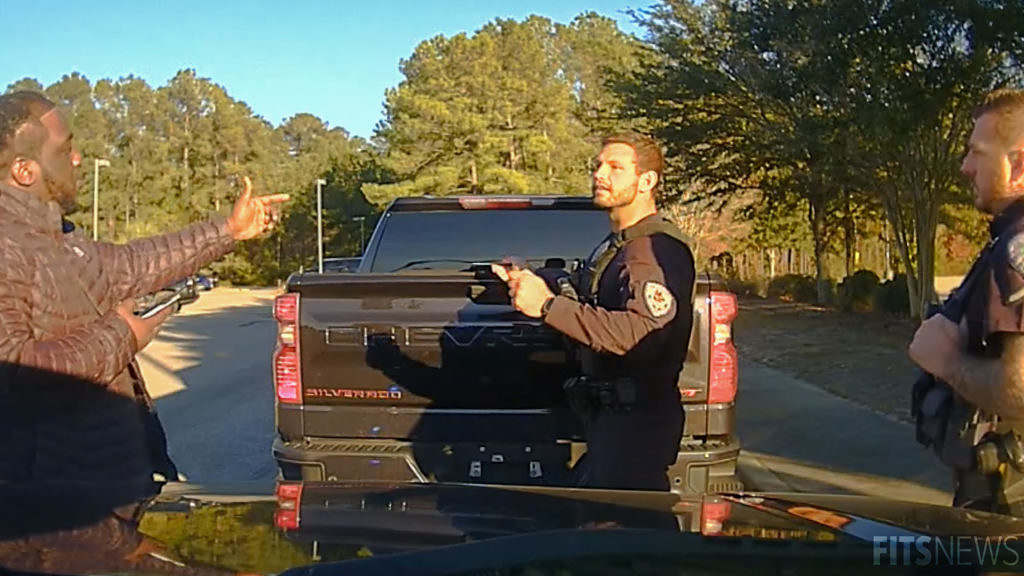
At around 3:00 p.m. EST on December 6, 2024, then-K9 officer Jacob Bloomer initiated a traffic stop on a Chevy Silverado displaying what he described as an “unlawful” window tint and a dealer license plate, according to the incident report released last week (.pdf).
The report noted the driver did not stop for blue lights immediately, instead driving slowly past one parking lot before pulling into another about half a mile away.
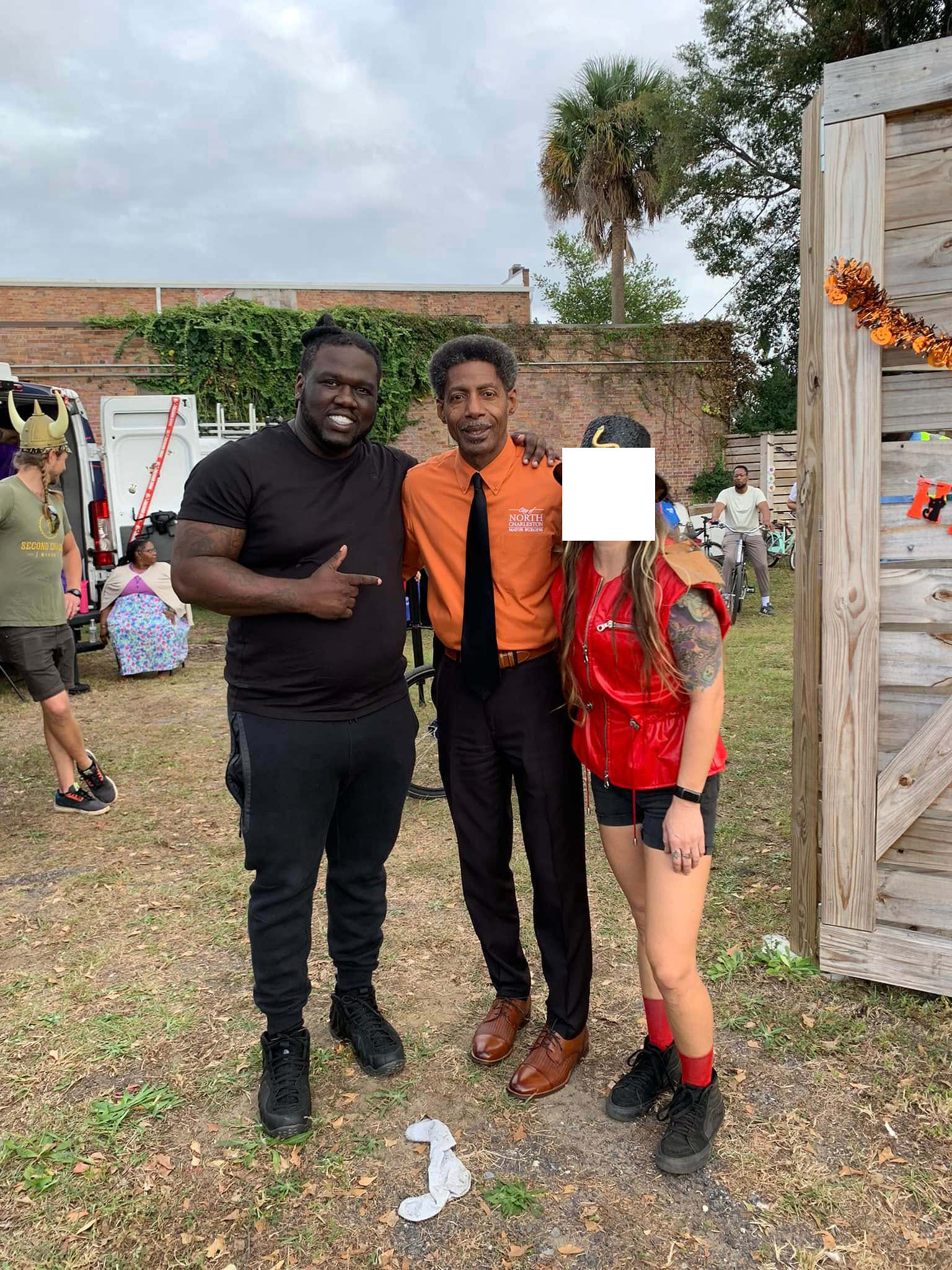
Per police records, the driver of the pickup was Ronald “Stunna” Smith — a prominent activist who rose to local recognition after his 14-year-old daughter was killed in the crossfire of a May 2021 gang shooting, according to multiple reports by The Post and Courier and others.
Smith — who founded Positive Vibes Ronjanae Smith in her memory — drew further media attention after the man convicted in her death was sentenced to just 10 years in prison, a punishment Smith openly criticized for mirroring the time he once served for drug charges.
In early 2024, he was featured in an NCPD social media campaign for Black History Month — just 10 months before Bloomer’s traffic stop.
“Upon making contact, the suspect [Smith] tried talking over me several times while attempting to introduce myself,” Bloomer wrote. “The suspect became verbally challenging to why I was looking in the vehicle after I asked him about the presence of any weapons.”
According to the report, Smith made comments the officer described as “abnormal behavior” for a traffic stop — including accusations of racial profiling after Bloomer asked him to exit the blacked-out pickup “due to his demeanor, possible weapons presence, and officer safety.”
“The suspect tried to be demeaning… as if I was performing the actions I was doing because I was racist, making statements such as, ‘Do it look like I’m a goddamn criminal? If a white man was driving this vehicle, you wouldn’t pull him out of the vehicle,’” the report continued.
***
***
Bloomer further noted that the dealer plate on Smith’s truck was registered to one business, while the vehicle title was tied to another — both listed at the same address. Smith claimed to own both companies and said he had recently sold the truck from one to the other, but provided no documentation.
That discrepancy, Bloomer wrote, violated state registration requirements and constituted improper use of a dealer tag — prompting NCPD to seize the plate. In response, Smith allegedly began “talking loudly and directly to [Bloomer’s] body camera in an antagonistic way.”
Notably absent from the three-page report is what the muted dash camera footage clearly shows: Smith was on the phone from the moment he stepped out of the pickup — and remained on the call as Bloomer removed the license plate from his Chevy.
After the plate was removed, Smith remained on the phone while standing in front of the patrol vehicle. He was issued a ticket for the “unlawful” window tint, then got back into his truck and drove out of view — despite the report stating he was “allowed to park.”
This, according to officers we spoke with, is where things stop adding up.
Later that afternoon, Bloomer wrote that Lt. Anthony King called and told him not to turn the seized license plate over to the S.C. Department of Motor Vehicles (SCDMV) — as required by state law — but to instead await another call for “further instructions.”
Around 4:30 p.m., Bloomer wrote, corporal Thomas Bennett called and “advised” that although the license plate was supposed to be submitted to the SCDMV, Bloomer should stay put because he was en route to retrieve it and return it to Smith.
“I inquired why and was informed, ‘because he’s connected apparently,’” the officer wrote.
Bloomer remained with the department until late April, when records show he was terminated just weeks after FITSNews submitted a FOIA request related to this traffic stop. Shortly thereafter, a history of the officer’s “repeated policy violations” was reported by local media.
Bloomer is now employed by the Charleston County Sheriff’s Office (CCSO), which declined to comment after he referred our inquiry to the agency’s public information officer.
***
OUR TAKE…

***
From the unexplained return of a seized license plate to a potentially unlawful delay in releasing public records — during which the officer who conducted a lawful traffic stop was fired — the events surrounding this incident mirror a familiar pattern at NCPD.
Cordray, previously found “not entirely truthful” by the same municipal government that concluded she sought to narrow the scope of an earlier public records request from this media outlet, once again took charge after we pressed the city with repeated follow-ups.
In the end, NCPD appeared to bank on short-term media memory — gambling that a delayed, piecemeal release would placate the public, even as a 33-year department veteran with a documented history of interference shaped what was ultimately disclosed.
This story may be updated.
***
ABOUT THE AUTHOR…
(Dynal Nolan/FITSNews)
Andrew Fancher is a Lone Star Emmy award-winning journalist from Dallas, Texas. Cut from a bloodline of outlaws and lawmen alike, he was the first of his family to graduate college which was accomplished with honors. Got a story idea or news tip for Andy? Email him directly and connect with him socially across Twitter, Instagram and Facebook.
***
WANNA SOUND OFF?
Got something you’d like to say in response to one of our articles? Or an issue you’d like to address proactively? We have an open microphone policy! Submit your letter to the editor (or guest column) via email HERE. Got a tip for a story? CLICK HERE. Got a technical question or a glitch to report? CLICK HERE.

5 comments
It still amazes me that people trust the popo. Popos hate FOIA’s and as a general rules will drag their feet and delay as much as possible complying as if just for spite if not to actually cover one of their thick blue line thugs.
The Freedom machine always needs scumbag thugs dressed in battle dress to enforce freedom and provide cover for their fellow trustees AKA public servants on the plantation.
Isn’t North Charleston’s radio traffic, like an increasing number of Secret Police agencies in SC, encrypted? The question that always screams to be asked is, what do they have to hide? There is no claim to transparency when a department feels it needs to hide behind encryption to keep the public in the dark.
Maybe they don’t want people with warrants knowing they’re closing in on them.
North Charleston has always been a corrupt mess. I think Cordray might as well pack her bags.
Why is Charleston County Sheriff’s department still speeding around with unlawful tint to windows? The darkness exceeds mandated state law. There are as there should be no exceptions for Leo vehicles. It is a criminal offense.
In South Carolina, window tint must allow more than 27% of light to pass through on front side windows, back side windows, and the rear window. The windshield can have non-reflective tint above the manufacturer’s AS-1 line.
Your reporting on Jacob Dalton Bloomer’s firing from the North Charleston Police Department (NCPD) and his 150+ policy violations was only the beginning. Records from a January 2026 incident show that since being hired by the Charleston County Sheriff’s Office (CCSO), Bloomer is repeating the exact “technical” and “procedural” patterns that led to his previous termination.
Evidence from recent discovery footage reveals:
The “Silent Stop” Pattern: During a high-stakes highway search in 2026, Bloomer’s BWC and dash-cam were devoid of all audio and metadata. This is the “classic trick” you documented in your July 2025 report. His camera functioned perfectly with full audio/GPS later that same day at a different location.
Obstructed “Find” & The Vest Reach: Video shows Bloomer’s body completely blocking the camera view of a vehicle’s floorboard during an alleged narcotics discovery. He is seen reaching toward his tactical vest at the exact moment the evidence is “produced.”
Safety Paradox: Despite reporting a find of “lethal fentanyl,” Bloomer handled the substance with bare hands and was caught on video rubbing his nose and face. He clearly demonstrated no fear of the substance, contradicting the “probable cause” used for the arrest.
Unreported Residential Search: Footage from the same day shows Bloomer at a residential building. This secondary search is entirely omitted from the official incident report for the morning highway stop.
The “recycled officer” issue is not just a theory; it is a documented danger to due process in Charleston County. Bloomer was fired for these types of violations in April 2025, yet he is back on the street using the same “missing audio” tactics to bypass the Fourth Amendment.