
|
Getting your Trinity Audio player ready...
|
Improper Disclosure?
The fallout from an Upstate student-teacher sex scandal continues…
The fallout from an Upstate student-teacher sex scandal continues…
|
Getting your Trinity Audio player ready...
|
5 comments
Family court judge has absolutely no jurisdiction over a criminal investigation into an adult suspect. Her “gag” order can’t enjoin anyone except the parties involved in the proceeding before her.
You can rail and preach about it, legislatures can pass laws against it and people can go to jail for it. but will never make it unpopular with the people.
The “statutory rape” laws have probably ruined more lives for no good reason than they have protected. As I understood it, South Carolina passed a law some years ago, that made it so a teacher could have sex with a student who is 18 or older, and be convicted of a felony which could send them to prison for up to ten years plus be on the sex offender registry for life. If true, this is wrong on so many levels. The lame excuse that “the teacher has power over the student” is bullshit. How many other situations can we think of where one partner in a sexual relationship “has power” over the other? Bosses and secretaries? Cops and citizens? Soldiers and citizens? Politicians and citizens? I mean, where do we draw the line on who government says can f-ck and who it says cannot f-ck, even when both parties want to? But some people actually want government making these decisions for them and their kids.
If a school district has a policy that says a teacher can be fired for having sex with a student who is of age, so be it. Punishment fits the “crime”. Destroying lives with felony convictions, sex offender registry for life, and other stupidity “because it sounds responsible” is just wrong.
This article seems to suggest that the ex-husband is the one behind posting the video, but there are several aspects of the story that don’t add up.
Firstly, the YouTube video only shows a small portion of the interview, and the channel does not feature any other videos offering the full context. If the ex-husband were truly trying to harass his ex-wife, wouldn’t it make more sense for him to post a segment where she might say something incriminating, or where a detective reveals damaging information about her?
Additionally, many of the articles written by Mr. Folks appear to focus on attacking the ex-husband’s reputation while defending the ex-wife’s actions. The interview segment in question seems to fit this narrative, as it only mentions that the ex-husband reported the incident and that the charges were later dismissed. This raises the question: Is the full context being presented, or is the story being shaped in a way that benefits a particular perspective?
Furthermore, this isn’t the first time Mr. Folks has used family court documents to support his articles. In a previous piece, he published the final divorce decree before quickly removing it due to the sensitive nature of the information concerning the Pelfreys’ minor children. In this latest article, he includes a 2022 court order. This pattern raises a concern: Who has access to these documents, and what might their motivation be in continuing to provide them to Mr. Folks?
Finally, in the four articles Mr. Folks has written about Mr. Pelfrey, he frequently references “sources” without disclosing who they are. We are left to wonder: Who exactly described Mr. Pelfrey as “combustible,” or claimed that he was “shaking with rage”? Who said that “Pelfrey believed his wife should have spent several years behind bars” or that “he’s gonna lose his job”? Who provided the threatening letters and police reports?
While I understand that certain sources may need to remain anonymous, it’s difficult for readers to gauge the credibility of these stories without knowing more about these sources. How can we distinguish between fact and opinion? Could knowing the identities of these sources change how we interpret the information being presented?
I’m left questioning the intentions behind the articles—whether they are truly seeking to inform or if they’re an attempt to deceive by only providing one side of the story. Maybe the days off accountability, transparency, and trust will return to the foundation of journalism, but for now readers should arm themselves with scrutiny when reading articles lacking a solid foundation.
Why is perjury against the law?
In the recent FITSNews article about the possible harassment of Katherine Pelfrey by her ex-husband, Oconee County Sheriff’s Office officer Justin Pelfrey, the words of Judge Karen Roper in her judgment of the divorce were quoted: “While no one has been charged in connection with the threats (or the alleged animal cruelty), S.C. family court judge Karen S. Roper concluded last December that Justin Pelfrey ‘probably did’ leak news of his wife’s arrest to the media – noting his denials under oath did ‘not seem credible.’”
That is indeed what was in the final written order, but that is not what she said in court. Here is from the transcript of what she read in court: “[A]lthough there is no conclusive evidence that you were the one who sent the email messages to the media, I don’t need expert testimony to convince me that you [Pelfrey] probably did. The unfortunate thing is, I think anyone can understand you acting out this way, especially in the hours following the shocking news of your wife’s betrayal. But I don’t understand why you would feel the need to lie about it.”
Here’s the background. The night after the big blowup between Pelfrey and Katherine, someone emailed two local news agencies to alert them to the fact that Katherine was going to be charged with a felony. But who did it? In his testimony, Pelfrey was asked by Katherine’s lawyer if he had been the one to send those emails. He denied doing so. Later in the cross examination, Katherine’s lawyer asked Pelfrey if there was anything in his testimony that he would like to change, and Pelfrey again said “No.” (I cannot quote directly because I do not have the transcript of the trial—a transcript, which in my opinion should be in the public record, would cost about $5,000 to obtain).
But Katherine’s lawyer then presented an expert witness who researched the emails and demonstrated that they came from Pelfrey’s account. Pelfrey’s lawyer tried to claim that Katherine herself had sent these emails from Pelfrey’s personal phone, but the expert asserted that the emails came from a computer, not from a phone. This testimony came after Pelfrey’s lawyer went to great pains to demonstrate that Katherine had the children the night the emails were sent and that they were at a friend’s house all that evening, the older one in possession of Pelfrey’s personal phone. That is what motivated Roper’s assertion, “I don’t need expert testimony to convince me that you probably did,” though the earlier assertion that “there is no conclusive evidence” is, in my opinion, false. In other words, in court Katherine’s lawyer and the expert witness proved, probably beyond a shadow of a doubt, that Pelfrey lied about sending the emails.
Now, you may think, with Roper, that it was no big deal. But there were other accusations made about Pelfrey’s behavior. He was asked if he had poisoned the family dogs; he denied doing so. He was asked if he had sent threatening letters to Katherine; he denied doing so. If he had admitted to either of those accusations, he might have faced severe consequences, so it is no wonder that he would deny doing them. But he denied having sent a couple of emails to local news agencies, and Roper seemed to think “anyone can understand you acting out this way.” So if he would lie about that, as the transcript I think clearly demonstrates, who would be surprised if he lied about the other accusations?
Katherine Pelfrey was falsely accused of felony sexual battery. We know it was a false accusation based upon the facts of the case and also upon the fact that the solicitor not only dropped but expunged the charge. The penalty for such a felony is imprisonment up to five years. “Under South Carolina Code Section 16-9-10: Perjury is a Class F felony, punishable by up to 5 years in prison and fines up to $100,000.” Katherine was arrested and had her life turned upside down, but Pelfrey not only has not been charged but is employed as a law-enforcement officer in Oconee County.
I want that last fact to sink in. Justin Pelfrey, to whom Judge Roper said, “I don’t understand why you would feel the need to lie,” is empowered by Oconee County to carry a gun and a badge, is permitted to use violence when he wants to, and is required to testify against defendants in a court of law. That does not exactly make me feel comfortable, perhaps because I am not a defense attorney. If I were a defense attorney, I would love to know that Justin Pelfrey would be testifying against my client in court because I could ask him a question about his testimony in his own divorce trial, in which the presiding judge said, “I don’t understand why you would feel the need to lie.”
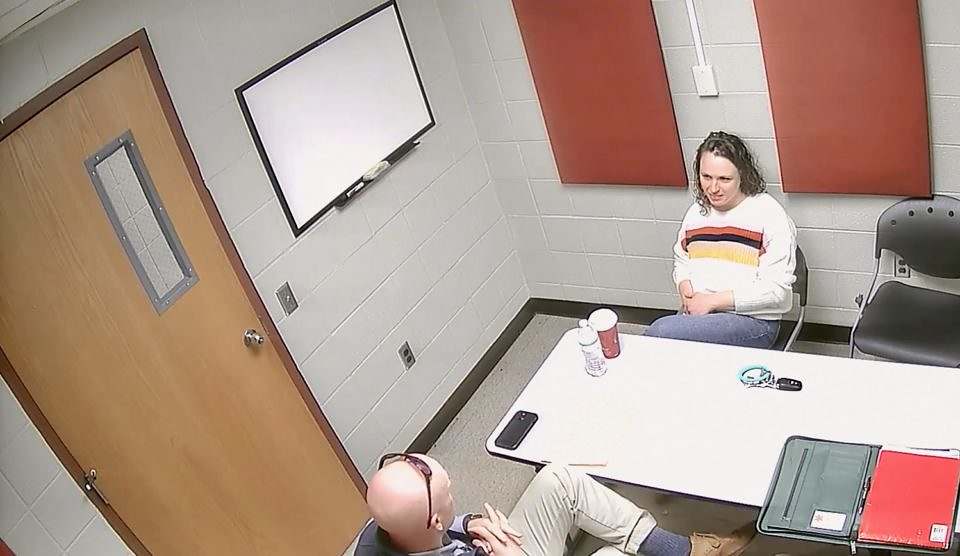
FITSNews’s most recent article about Pelfrey v Pelfrey covered how someone released video of Katherine Pelfrey’s interrogation by Pickens County officers, video that was released to Pelfrey and his attorney under a protective order but somehow made its way to YouTube. The question is, Who released it to YouTube? There are five possibilities: Katherine, her lawyer, Pelfrey, his lawyer, or the Pickens County Sheriff’s Office. The last, as I understand, was required to destroy the recording after the felony charge was expunged. The two lawyers were supposed to destroy their copies of the tape 60 days after the conclusion of the divorce trial (the tape was released to Pelfrey’s attorney for the sole purpose of using it in the divorce trial). If it turned out that one of the lawyers posted the video to YouTube, and if that lawyer was found out, he would very likely lose his license to practice law and perhaps even face criminal charges. It is hard to imagine either of them doing that. Katherine has absolutely no interest in keeping her name in the public space. That leaves only one person who might see a benefit in releasing the video to YouTube. Only one. I wonder what that person would say if asked about it under oath.
I have been told that nobody cares about perjury in family court. I assumed, when I heard that, that nobody cares about it because it’s always a “he said”/”she said” situation, and both sides will accuse the other side of lying, and neither side will have proof that the other side is indeed lying under oath. It may also be hard to determine whether what one person might consider a lie is actually just a misinterpretation of the facts, or perhaps ignorance about the facts. But I assume that there are times when it is clear that someone has lied, like in the Martha Stewart case. Perhaps my assumption is incorrect, but I hope not.
I hope not because I am profoundly troubled by the fact that a law enforcement officer, an officer of the court, could apparently lie under oath in court, if the words of the judge are to be believed, without suffering any consequences at all. I am troubled by the fact that a judge, an officer of the court, would assert that someone lied under oath in their courtroom but then feel so little respect for their own courtroom that they would do nothing about it. I am troubled by the fact that the lawyers involved, both officers of the court, would feel so little regard for the court they work for that they would do nothing about it.
Albert Einstein said, “Nothing is more destructive of respect for the government and the law of the land than passing laws which cannot be enforced.” I would add, “or which the government chooses not to enforce.” If we have a law against perjury, and if the officers of the court refuse to prosecute that law, what is the point of having that law? If people can lie under oath with impunity, respect for the courts and for the justice system is undermined. And respect for the government is undermined if an officer within the justice system, like a law enforcement officer, is allowed to commit perjury with no consequences.